The List Is a Mirror!
The names are interchangeable. What they own now is not. And we gave it to them.
I sat with the list this week. Not as a ranking. As a mirror.
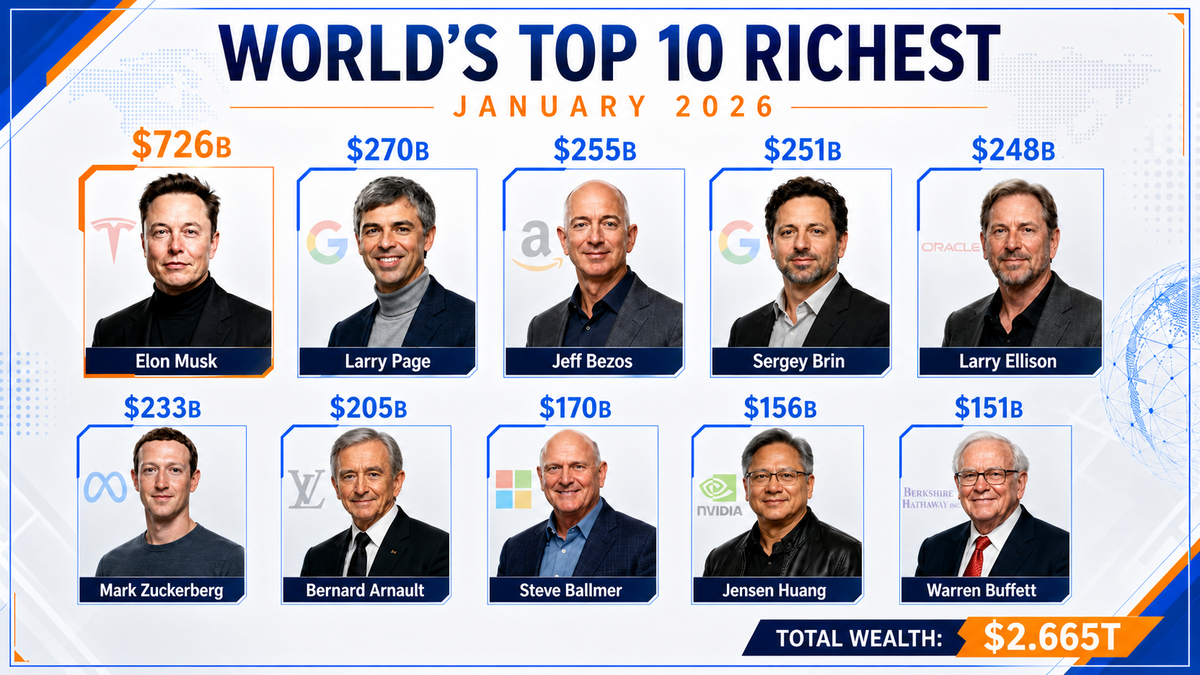
The Top Ten Richest of January 2026. Musk at the top. Then Page, Bezos, Brin, Ellison. Then Zuckerberg, Arnault, Ballmer, Huang, Buffett. The numbers are dazzling. The names are familiar. But sit with the image long enough and the ranking dissolves. What remains is a portrait of what humanity has decided is worth extracting.
This is not a celebration. It is a confession.
Wealth Has Always Worn the Costume of Its Era
Every civilization has had its rich men. The pharaohs of Egypt. The merchant princes of Florence. The Mughal aristocracy. The Ottoman pashas. The titans of American industry. Every culture, every era, every continent. The names change. The pattern of accumulation does not.
But the object of wealth has always told us what civilization was building.
Land told us we were agricultural. Ships told us we were commercial. Factories told us we were industrial. Oil told us we were mechanized. Software told us we were digital.
Look at the list now. Most of these fortunes were not built from oil, not from steel, not even from land. They were built from attention. From data. From prediction. From the platforms through which billions of people now form their friendships, their opinions, their memories, their politics, their grief.
"Every civilization tells us what it values by who it makes rich. Read the list slowly. It is not a ranking. It is a verdict."
They Now Own the Medium of Thought
This is the part history will mark. Caesar did not own Roman dreams. The Medici did not own Florentine imaginations. Rockefeller owned what fueled your car. He did not own what your children read at bedtime. Carnegie owned the steel beneath your feet, not the words above your head. That has changed.
For the first time in recorded history, the wealthiest individuals on earth own not just resources, not just industries, but the medium through which most of humanity now thinks. The platforms where children learn. The algorithms that surface what we read. The artificial intelligence that drafts our emails, answers our questions, recommends our politics, and slowly trains us in what to expect from a sentence.
This is not a quarterly shift. It is a civilizational one.
It does not matter whether the men on the list intended this outcome. Intention is not how history is written. Consequence is.
"When the richest men in the world own the medium of your thoughts, the question is no longer how rich they are. The question is what is left of you."
Notice What the List Refuses to Show
A list reveals as much by what it omits as by what it crowns. There is no woman. There is no African. There is no Latin American. There is no one whose fortune was built by curing populations, restoring ecosystems, rebuilding cities, educating the displaced, or feeding the hungry.
Capital is not neutral. It flows where it is allowed to flow, and it refuses to flow where it is not. The map of the world's wealth is also the map of what we have agreed not to value. We have agreed that healing does not pay what surveilling pays. We have agreed that teaching does not pay what advertising pays. We have agreed that mothers and farmers and nurses and caretakers produce nothing worth measuring.
Every civilization makes this choice. Every civilization, in time, is judged by it.
I am not arguing that wealth is an accusation by itself. Building things requires capital. Inventing things requires risk. The men on this list, whatever else may be said of them, did not arrive there by accident. But every empire produces its merchant princes, and history does not remember the merchant princes by what they accumulated. It remembers them by what they did with what they accumulated.
The Medici funded Michelangelo. They funded Galileo. They commissioned the cathedrals that still pull travelers across oceans. The Abbasid caliphs translated Greek philosophy and built Bayt al-Hikma. The Ottoman sultans built foundations that still feed the poor in Istanbul today. The pharaohs left libraries and hospitals beside their tombs.
What will this generation of merchant princes leave? Rockets, perhaps. A few universities renamed in their honor. Foundations whose mission statements blur into one another. And a great deal of accumulation that has not yet decided what it wants to be.
The verdict is still open. But the clock is not patient.
The List Is Not About Them. It Is About Us.
Here is the harder confession. We made these fortunes. Every minute we scrolled. Every recommendation we clicked. Every video we let autoplay. Every child we handed a screen to keep them quiet. Every conversation we deferred because the notification was louder than the person across the table.
The wealth on that list is not extracted from nothing. It is extracted from us. From our attention, our patience, our boredom, our loneliness, our families, our nights.
The question the list asks is not whether they are too rich. The question is whether we are still rich in the things that wealth cannot be measured in. Time. Presence. Conversation. Thought that has not been pre-shaped by an algorithm. Children who can sit in silence without reaching for a screen. Friendships that survive without notifications.
These are the assets that do not appear on any ranking. These are the assets we are quietly losing while we admire the men at the top.
"The richest men in the world cannot give us back the time we gave them. We can only stop giving."
The list is a mirror. We can keep staring at it. Or we can turn around.
Prof. Bassem Khafagy 02 May 2026

#BassemMoment #HumanConnection #Conversation #Civility #PublicDiscourse #Wisdom #Polarization #Communication
If you like Bassem Moment, and want to support it, there are a few ways:
- ⏩ Forward the newsletter to a friend with an invitation to Join US.
- 📧 Share your comments and let us all learn from you.

Prof. Bassem Khafagy : An academic leader, best-seller author, award winning researcher, and strategic thinker whose work spans the United States, Europe, and the Middle East. He is currently dedicating his time to rethinking the “University” as a transformative force in society. Prof. Khafagy is the founding force behind several global academic initiatives, most notably the World Universities Foundation, WUF, World Summit on Universities, WSU, and the Re-Imagine University Newsletter & book series.
The visual compositions throughout this newsletter and the series are original copyrighted works by Prof. Bassem K. Khafagy. They are crafted using advanced technological tools, including artificial intelligence, guided entirely by the writer's artistic vision and design sensibility. In a series about being you, it felt only right that the art itself reflect that spirit of creative possibility. © All rights reserved, 2026.